The Yield Opportunity Isn't Hidden. The Problem Is Getting To It.
Anthony Mandelli
April 22, 2026
Ymax
Yield
yield farming
defi
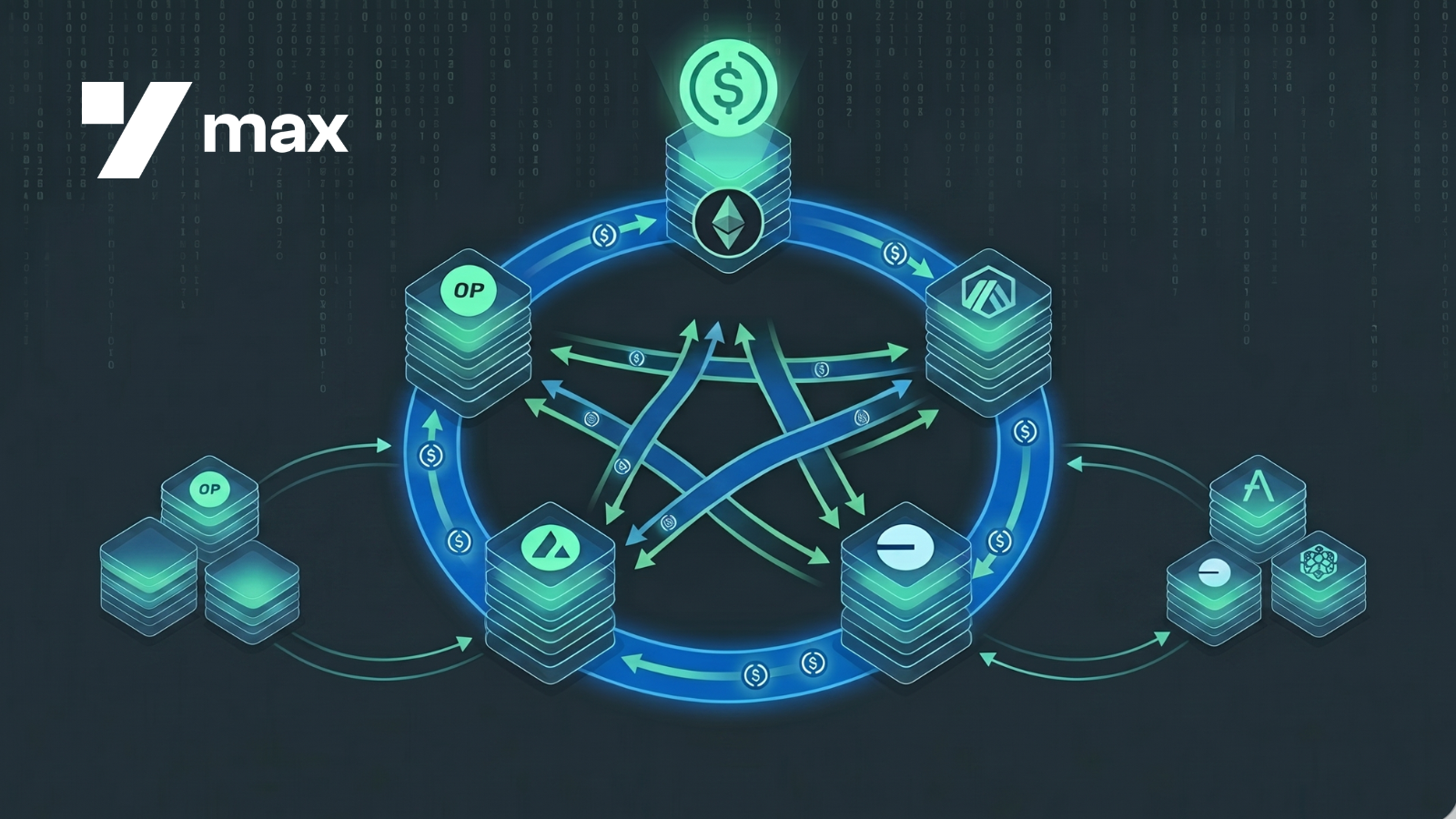
Along with Sommelier, we ran a backtest.
Covering 817 days, 5 chains, and 34 pools across 11 protocols with $100,000 starting capital, the goal was simple. We wanted to quantify exactly how much yield is left on the table when capital stays in one place. The results were unambiguous, and they point to something bigger than a yield gap.
What the Data Said
Across 27 months, the best-performing single-chain strategy, Ethereum, returned 14.35% annualized. Base returned 9.23%. That's a 512 basis point gap between two chains that most DeFi users treat as roughly interchangeable depending on gas costs. But the more important finding wasn't the chain gap, it was the rotation pattern.
The best chain changed five times across nine quarters. Arbitrum dominated Q1 2024 during incentive season. Ethereum took over when Ethena sUSDe yields spiked above 20%. Arbitrum came back. Then Ethereum reasserted as Pendle structured products emerged as the new yield leader. No one predicted this sequence, there was no way they could have. The yield frontier continuously shifted to protocols and asset types that didn't exist or weren't competitive one quarter earlier.
A cross-chain strategy rebalancing weekly captured 14.24% annualized after bridge costs, within 12 basis points of the theoretical best. The strategy didn't require predicting which chain would win, it just required the ability to move. The asset rotation finding compounds this. Three asset types each dominated different periods: USDC for 57% of days, Ethena sUSDe for 25%, and Pendle SY for 18%. A USDC-only strategy, which describes most stablecoin portfolios, missed 43% of the available yield opportunity.
The data makes one thing clear. The yield opportunity isn't hidden, rather the problem is operational. Capital doesn't move because moving it is (still) too hard.
This Is a Structural Problem, Not a UX Problem
It's tempting to frame this as a user experience issue because of too many tabs, signatures, or chain-switching. Simply fix the interface and fix the problem. That framing is too narrow. The real issue is that DeFi capital management has no coordination layer. Every rebalance, every bridge, every protocol deposit is a separate job. Multiply that across three chains, four protocols, and two asset types and you have a full-time operational workload for what should be a passive allocation.
Most users don't do it. Not because they don't know the yield is higher elsewhere. Because the cost of capturing it, measured in time, complexity, and attention, exceeds the incremental benefit of any individual rebalance. The result is a DeFi ecosystem where hundreds of billions in capital is systematically under-optimized because the execution infrastructure doesn't exist to act on what the market is already showing you.
Yield orchestration is the missing layer. A coordination layer that takes portfolio-level intent like "keep my USDC in the highest-yielding position across these chains and protocols," and handles everything required to maintain that state continuously.
Why the Next Era Makes This More Important, Not Less
Here's where it gets interesting.
A reasonable objection to the coordination problem is that AI agents will solve it. If agents can monitor rates, identify opportunities, and execute transactions autonomously, the operational overhead disappears. The friction argument goes away. This is partly right. Agents will absolutely change how DeFi capital is managed. The question is: what infrastructure do those agents run on?
An agent that can move your capital needs authority to do so. Most tools today grant that authority through API keys, broad wallet permissions, or session keys, all mechanisms that give agents wide latitude with limited enforcement of what they can actually do. The agent can rebalance your portfolio. It can also, in principle, withdraw to an unapproved address, bridge to an unapproved chain, or act in ways you didn't intend. The boundary between "authorized" and "unauthorized" is a policy promise, not a technical constraint.
This is the architectural gap that matters. Automation without confinement is a different kind of risk, not a solution to risk.
The infrastructure layer that agents need is execution rails with enforced boundaries where an agent authorized to rebalance within approved protocols cannot, by construction, act outside that scope. Where the authority granted to an agent is scoped, revocable, and enforced on-chain. "The agent can't do that" should be a technical guarantee, not a policy one.
Where Ymax Fits
The backtest proved that a cross-chain, multi-asset rebalancing strategy materially outperforms any static single-chain allocation and does so without requiring any predictive assumptions about which chain or protocol will lead next quarter. The execution problem that prevents most portfolios from capturing this is exactly what Ymax is built to solve. In its current form, one signature initiates a multi-step, cross-chain allocation workflow. No manual bridging or network switching. Capital moves to where it needs to be, and every step is previewed, transparent, and non-custodial before you sign.
But the more significant piece is what's being built on top of that execution layer. Ymax is building toward a model where automated strategies, and eventually agents themselves, can act on your portfolio within strictly defined, on-chain enforced boundaries. An agent that can rebalance across approved protocols when yield conditions shift that cannot, by construction, do anything outside the scope you defined. The authority is delegated and confinement is enforced while you retain override rights at all times.
The first live proof of this model is already running. An external strategy system is connected to Ymax's execution infrastructure, applying automated yield optimization without taking custody of user funds. The near-term roadmap extends this to hosted automation for users to set allocation rules that execute automatically when yield conditions shift, without requiring a manual signature for each rebalance. And beyond that, a hosted agent that manages your portfolio continuously, within your guardrails, with full on-chain auditability at every step.
The backtest showed what's possible when capital moves freely across chains and assets. The infrastructure being built is what makes that possible continuously, automatically, and safely for human users today, and for agent-driven capital management as that becomes the dominant model.
Ymax Early Access is live! Join now for one signature, cross-chain execution to keep your capital working.
Backtest period: January 1, 2024 – March 27, 2026. Data source: DefiLlama Yields API. Simulated historical performance. Past performance does not guarantee future results.